Strategy
SaaS SEO Strategy: A Stage-by-Stage Playbook for UK Software Companies
A SaaS SEO strategy is a plan for winning organic search traffic that turns into trials, demos and subscriptions. Start with pages for buyers who are already comparing software, such as alternatives, comparisons and use-case pages. Add educational content, free tools and links as your authority grows, and measure pipeline, not traffic.
Software as a service (SaaS) is a cloud model in which a provider delivers application software, most often for a subscription, and Wikipedia also lists freemium among the common models. That changes what organic search has to do: the sale rarely ends at the first visit, and buyers may read several pages over months before they act. Our B2B SEO strategy guide covers buyer profiles and buying committees. This guide covers what is specific to software. Sources are checked as of 31 October 2026.

What is SaaS SEO?
SaaS SEO is the strategy and tactics a software company uses on its marketing site to bring in organic search traffic from likely buyers. The aim is to turn that traffic into free-trial sign-ups, demo requests or paid subscriptions. Marketer Milk describes it that way. Backlinko adds the goals: attract likely customers, build brand authority, match search intent and grow traffic without paying for ads. Marketer Milk says companies invest because SEO can reduce reliance on paid ads and social media algorithms.
How is SaaS SEO different from traditional SEO?
The mechanics are the same, but the context is different. Marketer Milk calls "SaaS SEO" mostly a buzzword, because the core is traditional SEO tailored to subscription software. Oliver Munro agrees that keywords, content, links and technical foundations do not change. He names three things that do. Buyers may read several of your posts over months before requesting a demo. A stripped-back product feature can be offered free and rank. And a new category may have almost no search volume.
Flowlu adds that recurring revenue means SEO also supports retention, through onboarding guides, feature updates and FAQs. Flowlu and Backlinko also argue that SEO lowers customer acquisition cost over time, because content keeps working after publication while paid costs scale with each click. Neither shows evidence, so treat it as a hypothesis to test with your own numbers. Because the buying cycle is long, judge content on more than direct conversions: a guide that never produces a form fill may still shape a deal later.
Is SEO the right channel for your SaaS right now?
Not always. SEO suits SaaS products whose buyers search for solutions in a category with winnable demand, and it suits self-serve products where a ranked page can lead straight to a trial. It suits less when the market is tiny, you sell to a named shortlist through outbound, or you have not found product-market fit.
Munro makes this point first: a failure of channel selection is not a failure of execution. Marketer Milk quotes Brian Balfour's term for it, "product-channel fit". The table below is our synthesis of both.
| Question | SEO is a good bet if... | Wait or rebalance if... |
|---|---|---|
| Do buyers search for solutions? | Mid-market buyers research for weeks, read comparison articles and look for alternatives | Buyers come from referrals, analyst reports and outbound |
| Is there search demand? | The category has established demand and pockets you can win | Only a few hundred companies could ever buy, or nobody searches your category yet |
| Is the product proven? | You have product-market fit and a settled ideal customer profile | Messaging is still changing, so content will need rebuilding |
| Can a page convert directly? | The product is self-serve or product-led, so a ranked page can lead to a trial | You sell six-figure contracts to a shortlist |
| Is it B2B or B2C? | B2B tools that solve business pain tend to benefit most | B2C apps are trickier, according to Marketer Milk |
If the answer is "wait", SEO still has a role. Munro says it should not be where a limited marketing budget goes first.
How do you build a SaaS SEO strategy?
Build it in seven steps, in this order. The early steps decide whether to invest, and the later ones decide what to publish and how to prove it worked.
- Check channel fit and set a pipeline goal. Decide that SEO suits your product and what it must deliver.
- Map how your buyers search. Group searches by how aware the buyer is of the problem and of your product.
- Choose keywords by buyer fit, not volume. Prefer searches your exact buyers make and you can win.
- Build the right pages in the right order. Start with comparison and use-case pages.
- Fix the technical problems that hit SaaS sites. Check app subdomains, duplicate URLs, documentation and heavy scripts.
- Earn links and mentions. Use original data, free tools, integrations and real community presence.
- Measure pipeline and refresh. Track sign-ups and revenue, and update pages before they decay.
Step 1: Check channel fit and set a pipeline goal
Use the table above, then set a goal in pipeline terms: trial sign-ups or demo requests from organic search, not traffic. Backlinko suggests defining the goal first, such as building awareness, driving visitors to key landing pages or converting readers, and then tracking against it.
Munro puts the common failure plainly: most SaaS companies do not have an SEO problem, they have a prioritisation problem. Write the goal down and use it to say no to work that does not support it.
Step 2: Map how your buyers search
Group searches by how much the buyer knows. Marketer Milk uses Breakthrough Advertising's levels of awareness: problem aware, solution aware and product aware. It prefers these to a linear funnel, which it finds too rigid. Backlinko uses the familiar top, middle and bottom of the funnel, with Omnisend's targets as examples: "how to send an automated email", "mass email service" and "omnisend pricing".
Audit your existing content against this map to find gaps. Marketer Milk then plans each quarter with a simple chain: choose an audience, then a topic, then keywords.
Step 3: Choose keywords by buyer fit, not volume
Volume is a proxy, not a goal. Munro asks three questions of every keyword: are the people searching my buyers, can I win it at my current authority, and what does the searcher do next? His example is "productivity tips" at 90,000 searches a month against "construction project management software for subcontractors" at 200. If you sell to construction firms, the second is worth far more.
Start with your customers, not a tool. Read sales calls and support tickets for the exact words buyers use. Then run a content gap analysis against direct competitors with a tool such as Ahrefs or Semrush, and work through the low-difficulty gaps first. Broad category terms are dominated by incumbents and review sites such as G2 and Capterra, so target specific variants. Our guide to how to do keyword research and our keyword research service explain the method.
Step 4: Build the right pages in the right order
Sequence matters more than volume. Munro warns that publishing fifty informational posts on a domain with no authority wastes effort, and says to start where buyer intent is highest and competition thinnest. Marketer Milk groups SaaS landing pages into product feature pages, solution or audience pages, vs and alternative pages, and template pages. The five content types below work in roughly this order.
Comparison and alternative pages
Pages such as "[competitor] alternatives" and "[your product] vs [competitor]" target buyers who already have a shortlist. Munro says they are less contested than broad terms and convert better than educational content. Write them honestly: buyers in evaluation mode are sceptical. Munro finds that a page that admits real trade-offs, including cases where a competitor fits better, converts better than one that wins every row.
Use-case and integration pages
Use-case pages target a specific job, such as "invoicing tool for freelance designers". They have lower volume than category terms but higher conversion and are achievable at low authority. Integration pages work when each one explains what data passes between the tools and which workflow problem it solves, as Munro describes.
Problem-aware educational content
Educational posts build topical authority and keep your brand present through a long buying cycle. Target them because your buyers search them, not because the volume is high. Munro says topic clusters only make sense once you have some authority; he puts that at around 5,000 monthly organic visitors. Marketer Milk adds that keywords come last, after the buyer's search journey.
Product-led tools and templates
A free calculator, template library or generator turns a feature into a page that ranks, earns links and leads into the product. Backlinko cites Notion's content calendar templates and Omnisend's email subject line tester as examples. Munro cautions that these cost more to build than a post, and that a mediocre free tool signals low product quality to exactly the buyers you want to impress.
Programmatic pages
Programmatic SEO builds many pages from a template and a data set, and suits integration, use-case and location pages. Munro calls it high-risk: done badly it produces hundreds of thin, near-identical pages that Google ignores or penalises. Google's spam policies name scaled content abuse, which is generating many pages mainly to manipulate rankings. Build programmatic pages only when each one gives the reader something distinct.
Step 5: Fix the technical problems that hit SaaS sites
Marketer Milk's short checklist covers the basics for a simple SaaS site. Submit a sitemap to Google Search Console. Add Organization schema to the homepage and Article schema to posts. Set canonical tags on every page and use 301 redirects sparingly. Marketer Milk prefers Webflow, but says WordPress, Ghost and Contentful can work too, as long as you control canonical tags, schema, sitemaps and redirects. Munro adds four SaaS-specific problems that account for most of the suppression he sees:
- App subdomain indexation: app screens hold thin, session-specific content that wastes crawl budget.
- Duplicate URLs from tiers, trials and parameters: each copy dilutes the authority of the canonical page.
- Documentation on the marketing domain: thin troubleshooting articles can lower crawl priority for pages that earn revenue.
- Core Web Vitals on script-heavy marketing sites: Largest Contentful Paint is the usual failure.
One correction: Munro suggests blocking the app subdomain in robots.txt. But Google says robots.txt is not a mechanism for keeping a page out of Google, and a blocked URL can still appear without a description. Use a noindex directive or password protection for pages that must stay out. Our guide to fixing technical SEO issues and technical SEO checklist cover the fixes.
Step 6: Earn links and mentions
Links remain one of the hardest parts of SaaS SEO. Munro says the advice "create great content and the links will follow" is mostly wrong, and that mass outreach, guest post networks and guaranteed monthly link packages rarely help. Marketer Milk likewise warns against low-quality sites, Fiverr link packages and private blog networks.
What works, according to Munro, is original data and digital PR, product-led pages, integration and partnership pages, and genuine community presence. Backlinko adds broken-link outreach and competitor link gap analysis. Remember Google's rule: its spam policies treat buying links as link spam unless they are marked rel="nofollow" or rel="sponsored". Marketer Milk also recommends three to five internal links from existing articles to each new post, and no orphan pages.
Step 7: Measure pipeline and refresh
Track the whole path from search to revenue, not just rankings. The ladder below is our synthesis of the metrics Marketer Milk, Backlinko and Munro mention.
| Rung | What to track | Where |
|---|---|---|
| Visibility | Impressions, clicks, rankings for target keywords | Google Search Console |
| Traffic quality | Organic visitors by page type: comparison, use case, blog | Google Analytics 4 |
| Intent | Organic visits to pricing and demo pages | Google Analytics 4 |
| Conversion | Free-trial sign-ups or demo requests from organic | GA4 conversions, CRM |
| Revenue | Paid conversions and subscription revenue by first organic landing page | CRM, billing, product analytics |
Marketer Milk connects Search Console and GA4, tracks conversions by page, and uses a Looker Studio dashboard and product analytics tools such as Amplitude or Mixpanel. Expect attribution to be imperfect, because no single read counts as a conversion. Then refresh: Marketer Milk updates old articles at least yearly, sometimes quarterly, and Munro says refreshing consistently beats new content for traffic recovered per hour. Our content refresh framework shows how to choose pages.
What should you do at each stage: build, grow or scale?
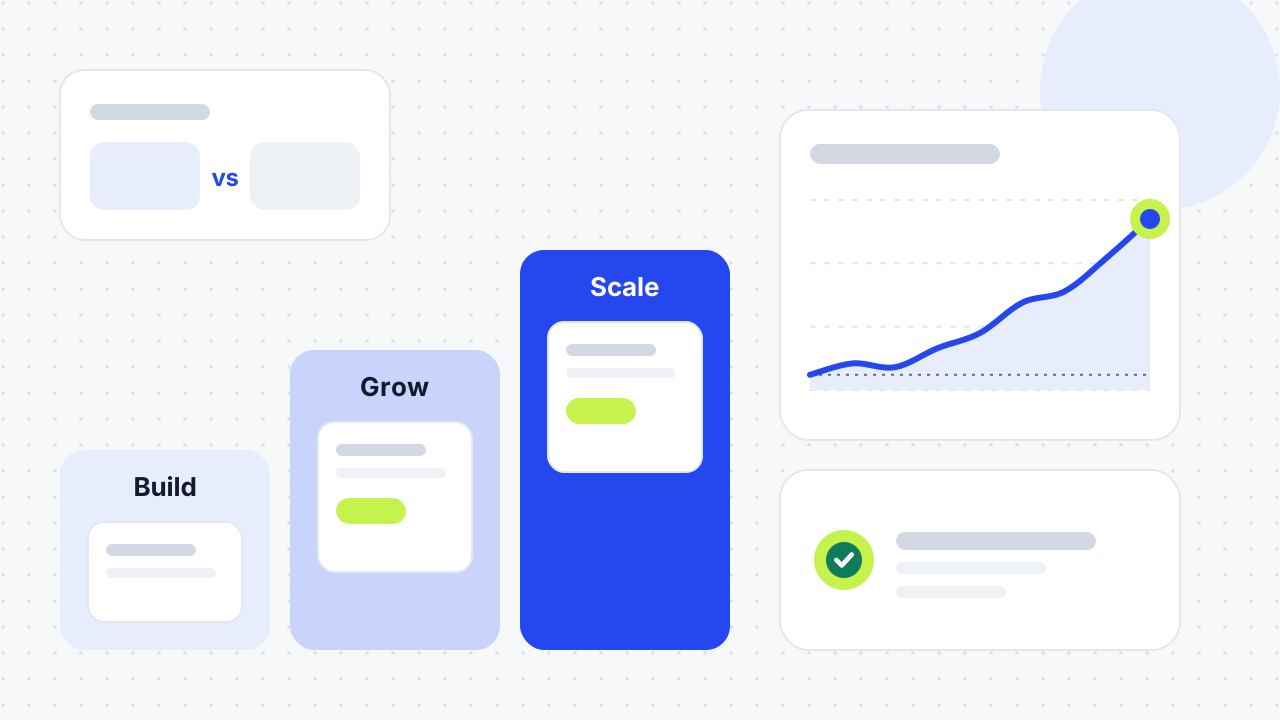
What works at one stage can hurt at another, so sequence your effort by stage. Munro's build, grow and scale model uses monthly organic visitors as a rough guide; the thresholds are his rules of thumb, not industry standards.
| Stage | Monthly organic visitors | Do first | Do next | Not yet |
|---|---|---|---|---|
| Build | 0 to 5,000 | Technical audit and fixes; comparison and alternative pages | Use-case and solution pages; targeted foundational links | High-volume informational content; programmatic pages |
| Grow | 5,000 to 50,000 | Topic clusters; problem-aware educational content | Product-led pages; deliberate internal linking | Programmatic SEO at scale; broad digital PR |
| Scale | 50,000 or more | Systematic content refresh; conversion work on high-traffic pages | Expanded link acquisition; adjacent keyword territory | New content verticals without conversion data |
The "not yet" column matters as much as the others. Each item is a legitimate tactic that becomes a distraction at the wrong stage.
How does AI search change a SaaS SEO strategy?
AI search changes the balance of content, not the foundations. Google's documentation says there are no additional requirements to appear in AI Overviews or AI Mode, nor other special optimisations. A page must still be indexed and eligible to appear with a snippet.
Munro's practical advice is to rebalance. AI answers absorb clicks on informational queries, but comparison and "best software for" queries still drive clicks, so weight your effort towards them. Getting cited in credible outlets, specialist communities and review sites also shapes what AI systems say about your category. Marketer Milk allows AI-assisted drafting if it is factual and reviewed by a person. Our guides to AI SEO and ranking in AI Overviews go further.
How long does SaaS SEO take to work?
Plan for months, not weeks, and expect sources to disagree. Marketer Milk suggests that an article which has not climbed after three to six months needs backlinks. Munro says meaningful organic pipeline takes nine to twelve months at minimum, often longer in competitive categories, and that well-run programmes see impact within twelve to eighteen months. Google says changes can take from hours to months to show an effect.
These are practitioners' estimates, not guarantees. A sensible approach is to check leading indicators such as impressions and rankings at six months, and judge pipeline at twelve. Our guide to how long SEO takes gives timelines by site type.
01Can I do SEO myself?+
Yes, for the early stages. Marketer Milk's author spends about two days writing a post, and Flowlu says SaaS SEO is achievable without large budgets, with on-page work as the top priority. Bring in help when you need a senior person to pressure-test priorities, fix technical problems or earn links. Our SEO consulting and SaaS and B2B SEO services cover that.
02Is SEO dead now with AI?+
No. Google says there are no additional requirements to appear in AI Overviews or AI Mode, and standard SEO practices still apply. For SaaS, the shift is towards higher-intent pages such as comparisons and alternatives, which Munro says still drive clicks, and towards credible mentions across the web.
03What is SaaS marketing SEO?+
It is SEO aimed at generating leads for a software product. Flowlu says it focuses on lead generation, which can be difficult, and recommends content built around target keywords plus link building. The goal is sign-ups and demos, not visits.
04What's the best B2B SaaS content?+
Flowlu names demos and case studies as strong choices, alongside a mix of educational and engaging content such as blog posts, comparison guides, industry reports and testimonials. Munro adds that comparison and alternative pages usually convert best. Keep navigation clear and update content regularly.
05Can I optimize a post that already has a few years?+
Yes. Flowlu says that if the post is still relevant and already indexed, updating and republishing it can make it more valuable. Change the "updated" date only when the content really has changed, because Google lists changing a date without a substantial update as a warning sign.
06Should a SaaS company try to outrank G2 and Capterra?+
Not at first. Munro says broad category keywords are dominated by high-authority incumbents and aggregators such as G2 and Capterra, and that you are unlikely to displace them early on. Target specific, qualified variants instead, such as a use case or an industry, where competition and buyer fit are both better.
07How do I track trial sign-ups from organic search?+
Connect your site to Google Search Console and Google Analytics 4 and track conversions by page. Marketer Milk also uses product analytics tools such as Amplitude or Mixpanel, filtering for organic Google traffic and excluding paid traffic tagged with UTM parameters. That shows which posts drive sign-ups.
08Should a SaaS company use AI to write blog content?+
Use AI to help, not to replace experience. Marketer Milk says human content with real experience performs best, and that AI can help if it is factual and reviewed by a person. Google's guidance on generative AI says mass-producing low-value pages can break its scaled content abuse policy and that output needs manual fact-checking.
09What landing pages does a SaaS site need?+
Marketer Milk lists four types: product feature pages, solution or audience pages, vs and alternative pages, and template pages. Add a pricing page and a demo or trial page for people ready to act. Backlinko lists pricing, reviews and testimonials, demos and feature pages as typical bottom-of-funnel pages.
10Is SaaS SEO different for B2C apps?+
Yes, it is trickier. Marketer Milk says B2C SaaS with mobile apps may not make SEO the main channel, and that it depends on industry, target customer and pricing structure. B2B products that solve business pain tend to benefit most.
11Can SaaS SEO work without a big budget?+
Yes, if you focus. Flowlu says on-page SEO should be the top priority and results take time. Munro's stage model also helps a small budget: start with technical fixes and a few comparison and use-case pages instead of publishing at volume.
12Does SaaS SEO need a separate strategy from B2B SEO?+
Mostly no. The groundwork is shared: a clear buyer profile, search-intent research, content and measurement, which our B2B SEO strategy guide covers. SaaS adds product-led pages, comparison and integration pages, app and documentation technical issues, and trial or demo conversion tracking.
Free SEO audit
Get a straight answer on what to fix first.
Request a free SEO audit and we will come back with the largest constraint on your organic growth and the first practical fix. No sales sequence.
Prefer to hire through Upwork? Hire me on Upwork