AI Overviews
How to Rank in AI Overviews: A Practical 2026 Guide
Google now answers many questions with an AI-written summary before anyone reaches the first blue link, and most advice on getting cited in one is guesswork. This guide sets out what Google says you need, what the large studies show, and a ten-step checklist you can work through this month.

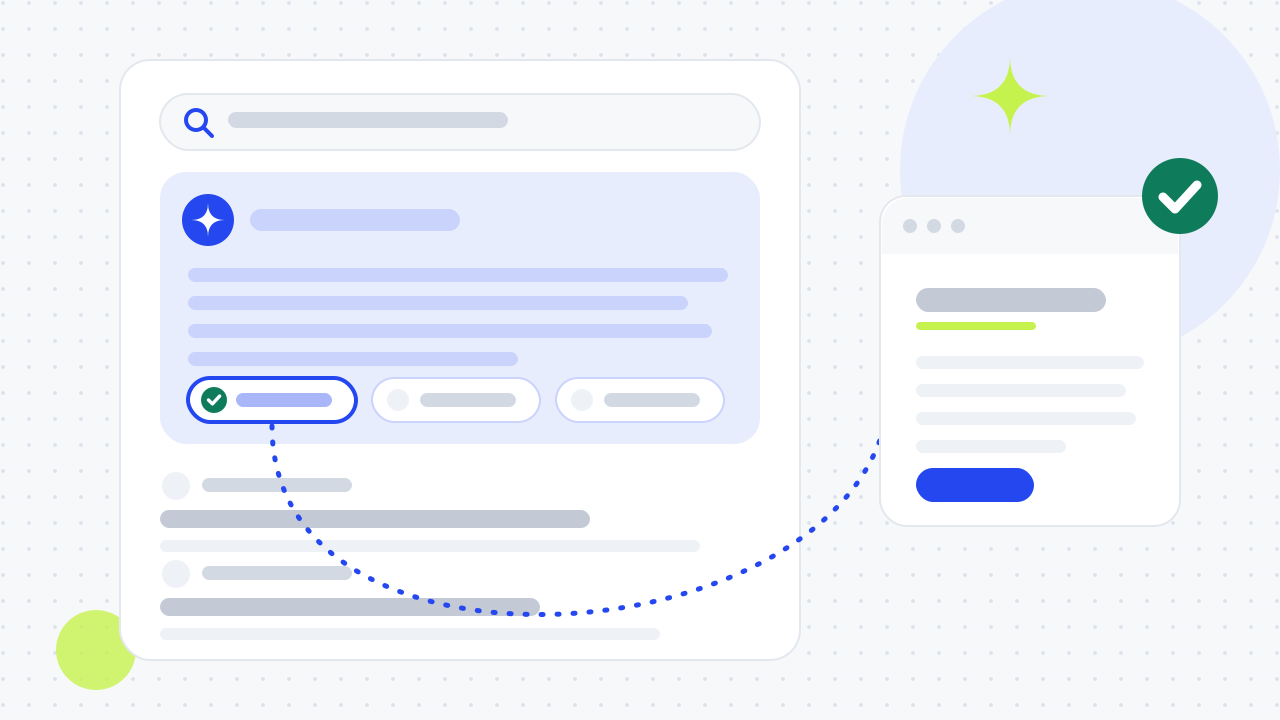
How do you rank in AI Overviews? The short answer
To rank in AI Overviews, a page must be indexed by Google, allowed to show a snippet, and able to rank for the question or one of the related searches Google runs behind it. No special markup is needed. Clear answers under clear headings and a brand other sites mention do most of the work.
That summary rests on Google’s own documentation, last updated in July 2026, and on large studies by Ahrefs and Pew Research Center. Five points change what you should do.
- Google says ordinary SEO is the requirement. A page must be indexed and able to show a snippet, and nothing more is needed technically
- Only 38% of cited pages rank in the top 10 for the search itself. The rest rank for related questions that Google runs in the background
- Google lists llms.txt files, special schema and "chunking" among the things you can ignore
- Search Console has reported AI Overview impressions for every site since 31 August 2026
- Local searches rarely show an AI Overview, so a local business should fix its Google Business Profile first
What are AI Overviews?
AI Overviews are summaries written by Google’s Gemini AI models that appear at the top of some Google search results, with links to the web pages the summary drew on. Google’s stated aim is to help people get the gist of a complicated question quickly and to give them links for exploring further.
The feature began in May 2023 as an experiment called Search Generative Experience. Google renamed it AI Overviews and launched it in the United States in May 2024. It reached the UK by August 2024 and is now available in more than 200 countries and territories. In June 2026 Google said AI Overviews had over 2.5 billion monthly users.
An AI Overview is not a featured snippet. A featured snippet quotes one page. An AI Overview is new text assembled from several pages, and Pew Research Center found that 88% of the AI summaries it examined cited three or more sources.
Google also runs a second AI feature called AI Mode, a separate view for longer questions and follow-ups. The two work in a similar way, and a later section covers the differences.
Which searches show an AI Overview?
AI Overviews appear mostly on longer, question-style searches for information. Google says they are shown only when its systems judge that they add something to the classic results, so they often do not appear at all.
Ahrefs analysed 146 million search results in 2025 and found an AI Overview on 21% of them. The rate varied widely by type of search.
| Type of search | Share showing an AI Overview |
|---|---|
| All keywords | 21% |
| Questions, such as "why" and "how" searches | 57.9% |
| Searches of seven words or more | 46.4% |
| Medical searches | 44.1% |
| Single-word searches | 9.5% |
| Local searches | 7.9% |
Pew Research Center saw the same pattern in the browsing of 900 US adults in March 2025. Of their Google searches, 18% produced an AI summary, rising to 53% for searches of ten words or more. Both data sets are from the United States. We have not found an equivalent UK study, so treat the figures as a guide to the pattern, not as exact UK rates.
The mix may be shifting. Ahrefs found that 99.9% of the keywords triggering an AI Overview had informational intent. Semrush’s own tracking puts the informational share at 89% in October 2024 and 57% in October 2025, as more commercial searches gained one. The two firms measure differently, but both agree on where AI Overviews are most common: guides, explanations and how-to pages. Service pages and "near me" searches are affected far less.
How does Google choose which pages an AI Overview cites?
Google builds an AI Overview by searching its own index, not by recalling an answer from memory. Its documentation names two techniques. Retrieval-augmented generation, also called grounding, means the model fetches relevant, current pages from the Search index and writes its answer from them. Query fan-out means the model runs several related searches at once to gather more material.
Google’s own example is the search "how to fix a lawn that’s full of weeds". Behind it, the system might also search for "best herbicides for lawns", "remove weeds without chemicals" and "how to prevent weeds in lawn". A page can be cited because it ranks for one of those hidden searches, even if it ranks nowhere for the original.
The data shows how much this now matters. In March 2026 Ahrefs published an analysis of 863,000 search results and four million AI Overview links.
| Where the cited page ranked for the original search | Share of AI Overview citations |
|---|---|
| In the top 10 | 37.9% |
| Positions 11 to 100 | 31.2% |
| Outside the top 100 | 31.0% |
In its previous study, in July 2025, about 76% of cited pages were in the top 10. Ahrefs links the change to Google moving AI Overviews to its Gemini 3 model in January 2026. It also improved its own measurement between the two studies, so part of the drop may be down to method.
Either way the lesson holds. Ranking still matters, because every citation comes from a page Google has retrieved through a search. The searches that count are the questions inside the question.
What does Google say you need to do?
Google says a page needs nothing beyond ordinary search eligibility. To be shown as a supporting link in AI Overviews or AI Mode, a page must be indexed and eligible to appear in Google Search with a snippet. Its documentation states that there are no additional technical requirements.
One site-level setting was added in 2026. A site must be included in Search generative AI features in Search Console. Inclusion is the default, so this matters only if someone has switched it off.
Beyond eligibility, Google’s advice is the SEO it has always recommended:
- Allow crawling in robots.txt, and check that your host or CDN is not blocking Googlebot
- Link to important pages from elsewhere on your site
- Put important content in text, not only in images or video
- Give visitors a good page experience: pages that work on a phone, load quickly and make the main content easy to find
- Make structured data match what is visible on the page
- Keep your Google Business Profile and Merchant Center details up to date
- Write "non-commodity" content: first-hand experience and detail that could not have come from just anyone
Google’s example of that last point is useful. "7 Tips for First-Time Homebuyers" is commodity content. "Why We Waived the Inspection & Saved Money: A Look Inside the Sewer Line" is not. Our guide to what SEO is covers these foundations in full.
Which AI Overview tactics can you ignore?
You can ignore most of the tactics sold as AI Overview "hacks", often under the labels generative engine optimisation (GEO) or answer engine optimisation (AEO). Google’s July 2026 guide to generative AI search has a section on what you do not need to do, and it contradicts a good deal of published advice.
| Tactic you will see recommended | What Google says |
|---|---|
| Adding an llms.txt file or other AI-only files | Not needed. Google Search does not use them |
| Special schema markup for AI | Structured data is not required for generative AI search and there is no special markup to add. Keep using it for rich results |
| "Chunking" content into tiny sections | Not required. Google can find the relevant part of a longer page, and there is no ideal page length |
| Rewriting pages in an "AI-friendly" style | Not needed. The systems understand synonyms and meaning without exact wording |
| Buying or seeding brand mentions | Inauthentic mentions are not as helpful as they seem, and spam systems still apply |
| Publishing a page for every variation of a question | Doing this mainly to manipulate results breaks the scaled content abuse policy |
This applies to Google. Other AI assistants have their own crawlers and rules, which we cover in our guide to AI SEO.
None of this makes structure pointless. Clear headings and direct answers help readers, and Google asks for pages organised into paragraphs and sections with headings. The warning is against paying for tricks.
How to rank in AI Overviews: a 10-step checklist
Work through these ten steps in order. The first two take minutes and rule out the simplest reasons a page is never cited.
1. Check the page is indexed and can show a snippet
Open URL Inspection in Google Search Console and confirm the page is indexed. Then check that the page has no nosnippet tag, no low max-snippet limit and no data-nosnippet attribute around the answer. These controls limit what Google may show in AI features as well as in normal results. If your site builds its pages with JavaScript, check in the same tool that the rendered page contains the answer text. Google can process JavaScript, but says SEO for JavaScript sites is generally more complex. A technical SEO review runs these checks across the whole site.
2. Confirm your site is included in AI features
In Search Console, open Settings and then Search generative AI. The default is to include your site’s links and content in Search generative AI features. If it has been changed to exclude, your pages cannot appear in AI Overviews or AI Mode.
3. Choose questions that trigger AI Overviews
Start with informational questions of several words, since those show AI Overviews most often. Prioritise topics where you already rank on the first or second page, because Google is already retrieving you for them. Our keyword research records which target searches show an AI Overview, and our article on connecting search intent to revenue helps you pick the ones worth winning.
4. Write down the questions inside the question
For each target, list the follow-up questions a full answer would need. The "People also ask" box and the related searches at the foot of the results are the best free sources. Running the question in AI Mode shows which sub-topics a full answer covers. Each one is a search you can rank for.
5. Answer each question in the first sentence under its heading
Give each question its own heading and answer it in the opening sentence, in words that still make sense if the paragraph is read alone. Avoid phrases such as "as mentioned above". This is good writing for readers first. It also means the passage Google retrieves contains the answer. Matching each page to one question in this way is the core of on-page SEO.
6. Use a table for comparisons and numbered steps for processes
Put prices, options and differences in a table, and processes in numbered steps. Google does not promise that any format is favoured, so do this because it is clearer to read, not as a trick.
7. Add what only you can say
Add the detail a competitor could not copy: your own prices, photographs of your work, the mistakes you see customers make, figures from your own jobs. This is what Google means by non-commodity content. Google says it is likely to influence your presence in generative AI search more, in the long run, than anything else in its guide. It is why our SEO content writing is built on your team’s knowledge, not on rewriting what already ranks.
8. Keep the facts current
Review the figures, dates and screenshots on your key pages at least twice a year and correct what has changed. An out-of-date page tends to slip in the rankings, and a page that is not retrieved cannot be cited. Change the "updated" date only when the content has really changed. Our framework for refreshing declining content shows how to choose which pages to update first.
9. Earn real mentions of your business
Ahrefs studied 75,000 brands and found that mentions of a brand across the web had the strongest link with appearing in AI Overviews: a correlation of 0.664, against 0.218 for the number of backlinks. Pew Research Center found that Wikipedia, YouTube and Reddit were the sources cited most often in the AI summaries it examined, together 15% of all sources. Correlation is not proof of cause, and Google warns against inauthentic mentions. The safe version is ordinary reputation work with customers, trade bodies, local press, suppliers and partners. Our link building services work this way.
10. Keep your Business Profile and product data accurate
Google says AI responses can include local business details and product listings. Check that your Google Business Profile has the right categories, hours and services, and that any Merchant Center feed is current. For online shops this is part of ecommerce SEO.
Do AI Overviews matter for a local business?
For most local searches, not yet. Ahrefs found that only 7.9% of local searches showed an AI Overview, against 21% of all searches. When someone searches for a plumber in Leeds, Google still leads with the map results and Business Profiles.
They matter for the questions customers ask before they choose a supplier. "How much does a new boiler cost?" and "Do I need planning permission for a dropped kerb?" are informational questions, the kind that show AI Overviews most often. A local firm that answers them well, with real local prices and experience, can be cited there.
So the order of work for a local business is clear. Get the Business Profile, reviews and location pages right first, which is the core of our local SEO services and the subject of our article on local SEO trust signals. Then publish answers to the questions your customers ask you every week. Our SEO agency Leeds page shows how the two fit together for one city.
Is ranking in an AI Overview worth it? What it does to clicks
Being cited is worth having, but it brings fewer clicks than a top ranking once did. Three findings set expectations.
- Pew Research Center: people clicked a normal result on 8% of visits to a results page with an AI summary, against 15% without one
- Pew again: people clicked a link inside the summary itself on just 1% of visits
- Ahrefs: across 300,000 keywords, the top-ranking page had a 34.5% lower click-through rate when an AI Overview was present
This is the zero-click search: the person gets an answer and leaves without visiting any site. Pew found that people ended their browsing session on 26% of results pages with an AI summary, against 16% of pages without one.
Google’s position is that the clicks which do come are better. It says visitors arriving from results pages with AI Overviews are more likely to spend more time on the site, although it has not published figures.
Our advice is to treat an AI Overview citation as visibility with some traffic attached. Judge it by enquiries and sales, not by sessions, and use our SEO ROI calculator to put a value on them. If a page’s clicks fall while its impressions hold, the page may still be doing its job of putting your name in front of buyers.
How do you track AI Overview rankings?
Track AI Overviews in Google Search Console first. Its Generative AI performance report shows how often links to your site appeared in AI Overviews and AI Mode. Google announced the report on 3 June 2026 and made it available to all sites worldwide on 31 August 2026.
| What you want to know | Where to look | Limits |
|---|---|---|
| Which of your pages appear in AI features | Generative AI performance report, Pages tab | Counts impressions. Google’s announcement lists no click metric yet |
| Which countries and devices | The same report, Countries and Devices tabs | Dates are in Pacific Time |
| Whether AI visibility brings visits | The main Performance report, Web search type | AI clicks are inside the totals but not separated |
| Which searches cite you | Search by hand, or use a paid tracking tool | Results change between searches, so one check is a snapshot |
If you cannot see the report, the usual reason is too few impressions in AI features. Google says so on its help page, and it is normal for a small or new site.
Manual checks need care. Ahrefs describes AI Overviews as non-deterministic, meaning the text and the links can change each time the search is run. Check the same list of questions each month and watch the trend. A paid tracker is worth the money only when you have enough target questions to justify it.
Can you opt out of AI Overviews?
Yes. Since 2026 a site owner can opt out in Google Search Console. Guides written before June 2026 say there is no opt-out, and that is now out of date.
The setting is called the Search generative AI control, under Settings. Choosing to exclude removes your links and content from AI Overviews, AI Mode and the generative AI features in Discover. Google says an excluded site receives no impressions or traffic from those features, that the control is not a ranking signal for the rest of Search, and that a change generally takes a few days.
Google tested the control with website owners in the UK first, from June 2026, and said it was engaging with regulators including the UK’s Competition and Markets Authority. It reached all sites on 31 August 2026.
Two older controls still apply. The nosnippet, data-nosnippet and max-snippet settings limit what Google shows from a single page. Google-Extended is different. It controls whether your content is used to train Gemini models, and Google states that it does not affect a site’s inclusion in Search. Blocking it will not remove you from AI Overviews.
For most businesses the right setting is the default. Opting out gives up visibility and gains nothing unless you have a specific reason, such as content that you sell.
Is ranking in AI Mode different from AI Overviews?
Ranking in AI Mode needs the same things as ranking in AI Overviews. Google applies one set of eligibility rules to both, counts both in the same Search Console report and controls both with the same setting.
The difference is in how people use it. Google describes AI Mode as suited to questions that need further exploration, reasoning or complex comparisons. It also says the two features may use different models and techniques, so the links they show for the same question will vary. AI Mode had passed one billion monthly users by June 2026.
In practice, a page that answers a topic and its follow-up questions well is prepared for both. Visibility in ChatGPT, Copilot and Perplexity depends on different crawlers and is covered in our AI SEO guide.
What mistakes keep pages out of AI Overviews?
Most pages that are never cited fail for ordinary reasons. These are the ones we would check first.
- Snippets blocked by a nosnippet tag left over from an old template
- The answer buried under a long introduction
- One page chasing the main keyword while the follow-up questions go unanswered
- Dozens of thin pages written for every variation of a question
- Money spent on llms.txt files or "AI schema" packages in place of better content
- AI-written text published without checking the facts
- Success judged on clicks alone
The second and third are also the cheapest to fix, because they need editing, not new pages.
Where to start this week
Start with the three checks that cost nothing. Confirm that your key pages are indexed and can show snippets. Confirm that the Search generative AI control is set to include. Then take your five most-visited guides and rewrite the opening of each section so that it answers its own heading.
If you would like a second opinion, request a free SEO audit for a written summary of what is holding your pages back. A full SEO audit goes further and puts every technical, content and authority issue in priority order. For the wider plan, see our SEO services.
01What is the difference between an AI Overview and a featured snippet?+
A featured snippet quotes a short passage from one web page. An AI Overview is new text written by Google’s Gemini models from several pages, with links to those pages. Both sit near the top of the results, and a page can appear in either.
02Do I need to rank on page one to appear in an AI Overview?+
No. In Ahrefs’ March 2026 study, 62% of the pages cited in AI Overviews ranked outside the top 10 for the search that triggered the overview. Many of them rank for a related question that Google searched in the background.
03Does schema markup help you rank in AI Overviews?+
Schema markup is not required for AI Overviews. Google says there is no special structured data to add for generative AI search. It is still worth using for rich results, and it must match what is visible on the page.
04Do I need an llms.txt file for AI Overviews?+
No. Google says you do not need llms.txt or any other AI-only file to appear in Google Search or its generative AI features, because Search does not use them.
05How long does it take to appear in an AI Overview?+
There is no fixed time. A new or changed page must be crawled and indexed first, and Google says recrawling can take from several days to several months. After that, appearing depends on the page being retrieved for a search that shows an overview.
06How long should a page be to rank in AI Overviews?+
Length does not decide it. Google says there is no ideal page length, and Ahrefs found almost no relationship between word count and being cited, a correlation of about 0.04. Answer the question clearly and stop when the topic is covered.
07Are AI Overviews available in the UK?+
Yes. AI Overviews reached the UK by August 2024, three months after the United States launch, and they now appear in more than 200 countries and territories.
08Why does my page appear in an AI Overview one day and not the next?+
AI Overviews are generated afresh, so the wording and the links can change each time a search is run. Google also says AI Overviews and AI Mode may use different models, which changes the links shown. Look at the trend over weeks, not one result.
09Does blocking Google-Extended remove my site from AI Overviews?+
No. Google-Extended controls whether your content is used to train Gemini models and to ground answers in the Gemini app. Google states that it does not affect inclusion in Google Search. To leave AI Overviews, use the Search generative AI control in Search Console.
10Does appearing in AI Overviews mean Google trains its AI on my content?+
Not by itself. Google treats the two separately. The Search generative AI control decides whether your pages can appear in AI Overviews and AI Mode, and Google says it does not affect AI training. Training is controlled with Google-Extended.
11Can I pay to appear in an AI Overview?+
You cannot pay for a citation. The links come from pages Google retrieves through its normal ranking systems. Be wary of any package that promises guaranteed placement in AI answers, because nobody outside Google controls that.
12Will AI Overviews replace SEO?+
No. Google says the best practices for SEO remain relevant because its generative AI features are rooted in its core Search ranking and quality systems. A page that cannot rank cannot be retrieved, and a page that is not retrieved cannot be cited.
Free SEO audit
Get a straight answer on what to fix first.
Request a free SEO audit and we will come back with the largest constraint on your organic growth and the first practical fix. No sales sequence.
Prefer to hire through Upwork? Hire me on Upwork