Content
Title Tags and Meta Descriptions: A Practical UK Guide
A title tag is the clickable headline of a search result, and a meta description is the short summary under it. Titles help search engines understand a page, while descriptions do not affect rankings directly, but both influence whether people click. Write a unique title and description for every page.
This guide covers what each tag does, when Google rewrites them, how to write both, how long they should be and how to audit a whole site. Sources are checked as of 12 November 2026.

What are title tags and meta descriptions?
What is the difference between a title tag and a meta description?
A title tag is the <title> element in a page's <head> and names the page. A meta description is a <meta name="description" content="..."> tag in the same place and summarises it. Google calls the title in results the "title link" and the summary text the "snippet".
Where do they appear?
The title appears in search results, in the browser tab and often as the headline when someone shares your link on social media. The description appears under the title in search results and can also appear in social previews. Both are written once but shown in several places, so check each one.
Are they ranking factors?
Titles are a small ranking factor, according to Ahrefs, so include the page's main keyword. Moz and Semrush both say meta descriptions do not directly affect rankings. Their value is in click-through: a clear title and description make your result the one people choose, which brings more traffic from the ranking you already have.
How does Google decide what to show?
Google builds the title link and snippet automatically from the page and from references to it, and it treats what you write as a preference, not an instruction. For snippets, Google says it primarily uses the content on the page and may use the meta description when it describes the page better than the on-page text. Semrush's own research found Google used the supplied description about 28% of the time, so treat the description as something Google may or may not use. Ahrefs reports that title tags differ from the search result title on 68.54% of the sites in its Site Audit data.
When does Google rewrite a title?
Google may change a title that does not reflect the page, and its documentation lists the common triggers. Each one has a simple fix.
| What Google lists | What it looks like | Fix |
|---|---|---|
| Half-empty title | <title>| Site Name</title> | Write the page name before the site name |
| Obsolete title | "2020 admissions" on a page that now says 2021 | Update the year, or leave it out |
| Inaccurate title | Keywords that do not describe the page | Describe what is actually on the page |
| Micro-boilerplate | Many pages with the same title | Add the detail that tells pages apart |
| No clear main title | Several equally large headings | Make the main heading distinct |
| Language mismatch | An English title on a Hindi page | Match the title to the page language |
| Repeated site name | Site name already shown by Google | Drop the duplicate |
How do you write a good title tag?
Describe the page in plain words, lead with what the searcher wants and keep it unique. Pages that share a title are often duplicate content or compete for one search, which our guide to keyword cannibalisation explains. Follow these steps:
- Pick the page's main keyword. Choose the phrase this page should win, based on search intent, and check that no other page targets it.
- Put it near the front. Moz recommends placing the primary keyword as close to the beginning as possible.
- Add one reason to click. A benefit, a price, a location or a qualifier such as "dates and penalties" gives a searcher a reason to pick you.
- Match your H1. Moz says matching the title tag to the H1 can reduce the chance of Google rewriting it.
- Add your brand last, or not at all. Google says to put only your site name at the start or end, separated by a hyphen, colon or pipe. The home page can carry more site information.
- Check it is unique. No two pages should share a title.
How long should a title tag be?
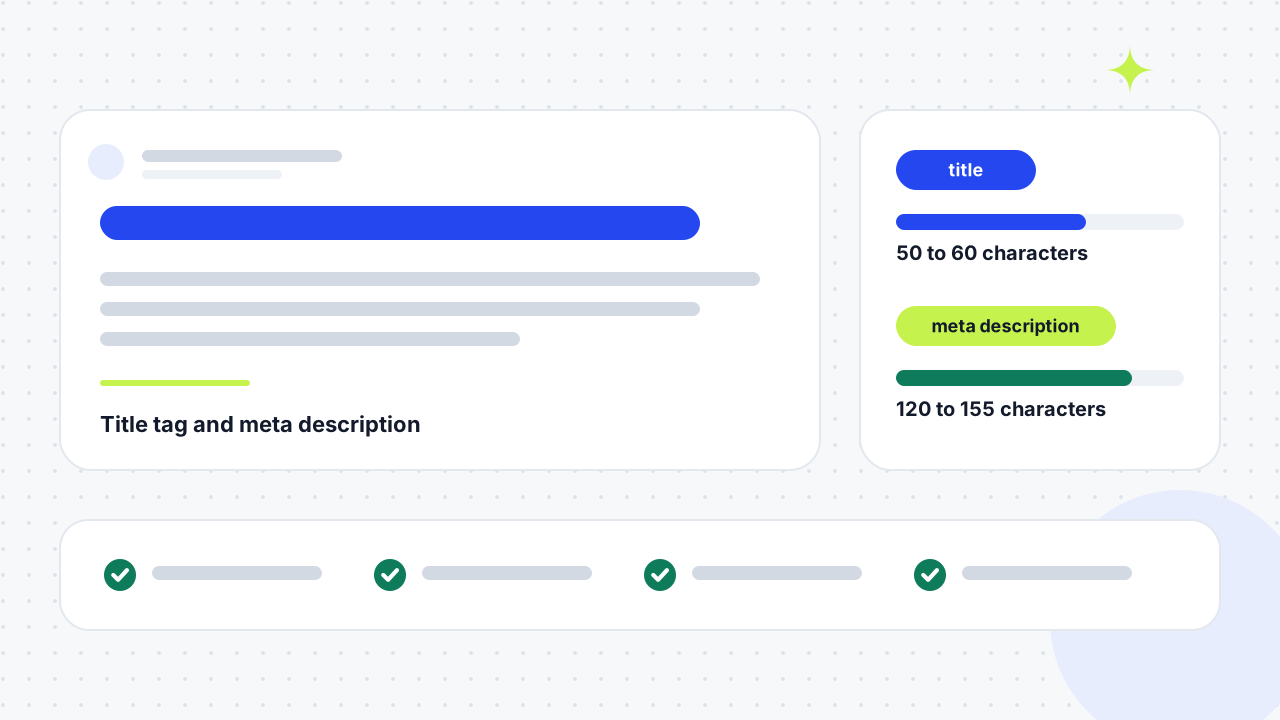
Google sets no limit, but it truncates titles to fit the device width. Moz found that titles of 51 to 60 characters tend to be rewritten least, and Ahrefs says Google measures pixel width and truncates or rewrites titles beyond about 600 pixels. Aim for roughly 50 to 60 characters, and put the important words first so a cut does not remove them.
Should you include your brand name?
Only where it helps. On our own site, most page titles no longer end with our brand name. We removed the exact-match brand name from them after it made About and Contact look like better matches than the homepage for the "seo agency leeds" search. Our keyword cannibalisation guide tells that story.
How do you write a good meta description?
Summarise what the page offers, lead with the most useful information and give a reason to click. Our on-page SEO checklist places both in the full page review. Follow these steps:
- Write one for every page. Google says identical or similar descriptions across a site are not helpful, and that site-level descriptions suit the home page and aggregation pages while page-level ones suit everything else.
- Say what is on the page. Include facts people look for, such as prices, dates, timescales or the author.
- Use the keyword naturally. Moz and Yoast suggest including the focus keyword. Google warns that long strings of keywords do not give users a clear idea of the page.
- Use an active voice and a call to action. Yoast and Semrush both recommend actionable, imperative wording such as "See prices" or "Book online".
- Make it match the page. Yoast warns that a misleading description can raise bounce rates and lower trust.
How long should a meta description be?
Google sets no limit either; it truncates snippets to fit the device. Yoast gives roughly 155 characters, with truncation on mobile at around 120. Moz gives 120 to 160, and Semrush recommends a maximum of 135. Put the main message in the first 120 characters and keep the total under about 155.
When should you leave the description to Google?
On very large sites, such as product databases or listings, write descriptions programmatically from real page data rather than by hand. Google's own guidance gives product aggregators as an example. If a page is long and answers many questions, Google may choose a better passage than the one you wrote, which is another reason to keep the description accurate rather than clever.
What do good UK title tags and meta descriptions look like?
Write for the people searching, in British English, with the place, price and format your readers use. These examples are invented for illustration; swap in your own facts.
| Page | Weak title | Better title (chars) | Weak description | Better description (chars) |
|---|---|---|---|---|
| Solicitor practice page | Home | Smith & Co | Family Solicitors in Leeds | Smith & Co Solicitors (50) | Welcome to Smith & Co. We offer a wide range of legal services. | Divorce, child arrangements and financial settlements from Leeds family solicitors. See typical timescales and fees, then book a free 20-minute call. (149) |
| Plumber | plumber leeds plumbing leeds cheap plumber | Emergency Plumber Leeds | Boiler Repairs | Brook Plumbing (57) | plumber leeds plumbing leeds boiler repair leeds cheap plumber leeds | Burst pipe or no hot water? Brook Plumbing's local engineers cover Leeds, Bradford and Wakefield. See call-out prices and book online. (134) |
| Café menu | Menu | Menu and Prices | Corner Café, Briggate, Leeds (46) | Our menu with all our prices. | Breakfast from £5.50, lunch from £7.95 and a gluten-free menu, all with prices listed. Open daily on Briggate, Leeds. (117) |
| Accountant guide | Guide | Self Assessment Deadlines: Dates and Penalties (46) | Read our guide to self assessment deadlines. | The Self Assessment filing and payment dates, the late-filing penalties and a short checklist of what to gather before you start. (129) |
The accountant title leaves the year out on purpose. Google's documentation uses an out-of-date year in a title as an example of what it may rewrite, so only add a year if you will update it.
How do you audit titles and descriptions across a site?
An audit finds missing, duplicate and weak titles and descriptions, then fixes the pages that matter most first. Our SEO audit checklist puts this in the wider audit order. Follow these steps:
- Export every page's title and description. Use a site crawler or your CMS to list them in a spreadsheet.
- Flag the problems. Mark missing, duplicate, very short and very long ones, and any that use the same text on several pages.
- Add [Search Console](/blog/gsc-opportunities/) data. Pull each page's impressions, clicks and average position for the last three months.
- Prioritise. Ahrefs suggests pages sitting around positions 4 to 10, which are ripe for title optimisation; also start with pages that have many impressions and few clicks.
- Rewrite and publish. Fix the highest-priority pages first and keep a record of the old and new text with the date.
- Check what Google shows. Search for the page and compare the result with your title and description. If Google rewrites it, compare against the table above.
- Review again. Look at clicks and click-through rate in Search Console a few weeks later, and refresh pages whose traffic has dropped.
01What is the title tag in HTML?+
It is the <title> element inside the page's <head>. Browsers show it in the tab, and search engines read it to understand and label the page.
02What is the difference between an SEO title and a meta description?+
The SEO title is the title tag, the clickable headline in the results. The meta description is the supporting summary beneath it. Each page needs its own version of both.
03How do you check a page's title tag?+
Look at the browser tab, view the page's source and find the <title> element, or run a crawler to list every title on your site. Search Console shows how pages appear for each query.
04Does the meta description affect SEO?+
Not directly. Moz and Semrush both say it is not a ranking factor, but a good description can improve click-through, which brings more visitors from the ranking you already have.
05Why is Google showing a different title or description from mine?+
Google builds both automatically and may replace yours if it thinks another version describes the page better for that search. Check your title against the common triggers in the table above and make sure it matches the page's content and H1.
06Can two pages have the same title tag?+
They can, but they should not. Google says each page needs distinct title text, and long titles that vary by only one detail make pages hard to tell apart in results.
07Should the title and H1 be identical?+
They do not have to be. The H1 is the heading on the page and the title is the HTML element in the head. Moz says matching them can reduce the chance of Google rewriting the title, so keep them close.
08How many words should a meta description be?+
Google gives no limit, and the practical limit is characters, not words. Aim for about 120 to 155 characters, which is roughly 20 to 25 words, and put the key message first because mobile screens truncate earlier.
09What makes a good SEO title?+
A good title names the page's topic in plain words, puts the main keyword near the front, adds one reason to click and stays unique to the page. Aim for roughly 50 to 60 characters so it is not cut off.
10How do you write a meta description example?+
Lead with what the page gives the reader, add a fact or two and finish with an action: "Divorce, child arrangements and financial settlements from Leeds family solicitors. See typical timescales and fees, then book a free 20-minute call."
11Can AI write my meta descriptions?+
It can draft them in bulk, but check each one. Semrush warns that AI systems can hallucinate false information, so confirm that every price, date and claim in a description is true for that page.
12Can I stop Google showing a snippet?+
Yes. Google provides the nosnippet meta tag to prevent a snippet and the max-snippet tag to set a maximum length. Most sites do not need either.
13How often should I update titles and descriptions?+
Review them when a page's traffic drops, when its content changes or when a year or price in the text goes out of date. Ahrefs says optimising titles is not a one-off task.
Free SEO audit
Get a straight answer on what to fix first.
Request a free SEO audit and we will come back with the largest constraint on your organic growth and the first practical fix. No sales sequence.
Prefer to hire through Upwork? Hire me on Upwork