Content
Content Marketing Strategy: A Step-by-Step Guide for UK Small Businesses
A content marketing strategy is a written plan that names your audience, your goal, the topics, formats and channels you will use, and how you will measure results. Write it before your content calendar: the strategy explains why you publish, and the calendar lists what and when.
Wikipedia describes content marketing as marketing built on creating, publishing and distributing content for a targeted audience. This guide turns that idea into a one-page plan in seven steps. It includes a worked example for a UK small business and covers three UK rules that most guides leave out: email consent, advert labelling and AI-written content. Sources and rules are checked as of 31 October 2026.

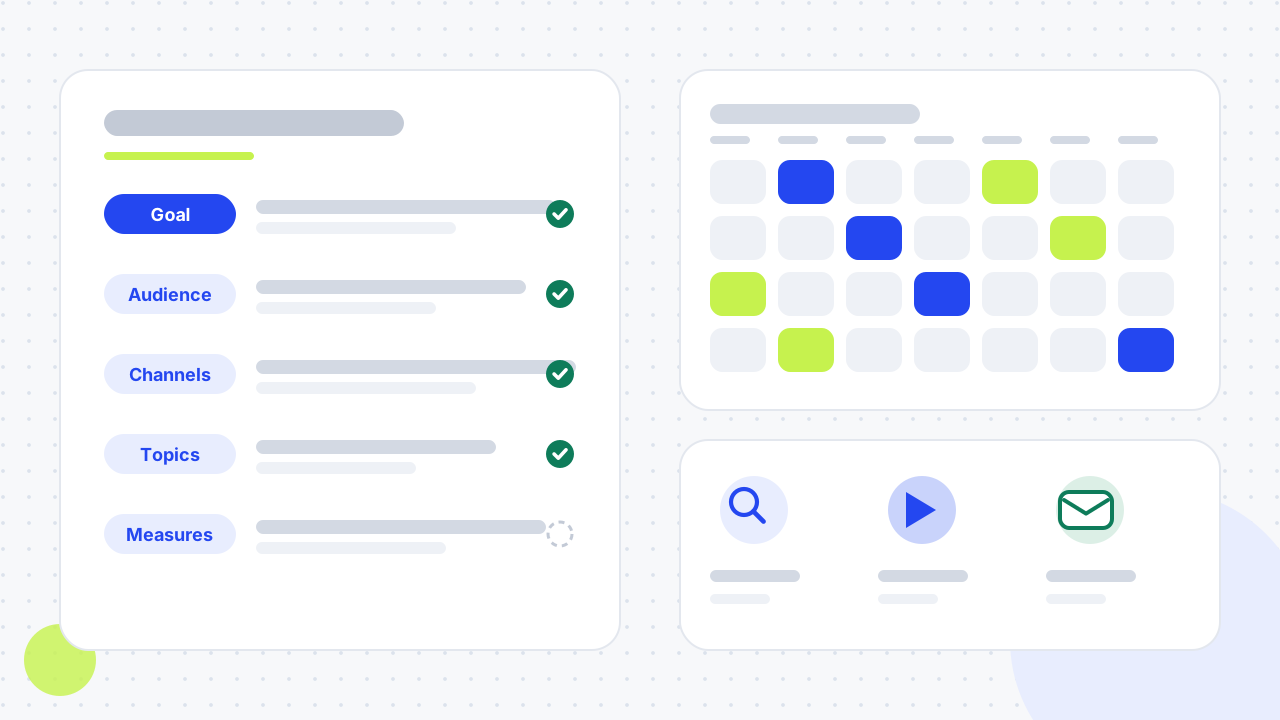
What is a content marketing strategy?
A content marketing strategy is the reasoning behind everything you publish: who you help, how you help them and which business results you want in return. The Content Marketing Institute (CMI) says it should outline your key business and customer needs and how content will meet them. Smart Insights frames the same idea as managing content as an asset that reaches, converts and engages a target audience.
How is it different from a content strategy and a content plan?
A content marketing strategy asks how content will help you reach an audience and meet marketing goals. A content strategy sets the rules for creating, managing and maintaining content across a whole organisation, and a content plan schedules the specific pieces, with formats, owners and deadlines. Semrush sets the three side by side:
| Term | What it is | Question it answers |
|---|---|---|
| Content marketing strategy | The overall approach to reaching an audience and meeting marketing goals | How will content help us reach our audience and achieve our goals? |
| Content strategy | Rules and processes for creating, managing and maintaining content | How do we keep content useful, consistent and manageable? |
| Content plan | The schedule and workflow for producing specific content | What will we create, when and how? |
Kristina Halvorson, quoted by CMI, describes content strategy as the "creation, publication, and governance of useful, usable content". CMI advises writing the strategy first and the plan second. Wikipedia places content strategy inside user experience design, next to information architecture and content management. A small business can treat it as a later refinement rather than a day-one document.
What should a content marketing strategy include?
CMI lists five components of a complete strategy: a business case, an operations plan, audience personas with customer journey maps, a brand story and a channel plan. Each answers a different question:
- Business case: why you are doing this, the risks, and what success looks like.
- Operations plan: how content will be governed, managed and measured, including resources and processes.
- Audience personas and journey maps: who the audience is, what they need and what content suits each stage.
- Brand story: the ideas and messages you will communicate and how they differ from competitors.
- Channel plan: where you will tell the story and how the channels connect.
For a small business all five fit on one page. Oracle's UK guide lists a similar set of elements: goals, context, funnel alignment, content type, budget, a calendar and KPIs. Context means the right content for the right person at the right time.
Does a small business really need a written strategy?
Yes, because a written strategy makes content easier to run and easier to judge. CMI's annual research finds that teams with a documented strategy consider themselves more effective, feel less challenged across content marketing and can justify a larger share of budget. Semrush gives the practical reason: a strategy helps you prioritise audiences, topics, formats and channels, simplifies production and gives you metrics for deciding what to continue, improve or stop.
The size of the document matters less than having one. A single page stops the pattern Google warns about in its people-first content guidance: producing lots of content on many topics and hoping some of it performs. Google lists that as a sign of content made mainly to attract search visits.
How do you build a content marketing strategy?
You build one in seven steps, in this order. Semrush's guide splits the work into eight steps and Oracle lists seven elements, so the count is flexible; the order is what matters.
- Set one measurable goal. Turn a business outcome into a SMART goal with a deadline.
- Research your audience. Learn who they are, what they ask and where they look.
- Choose channels and formats you can keep up. Pick fewer, and publish consistently.
- Pick topics from real questions. Use search data, communities and customer conversations.
- Build a content calendar. Rank topics, then give each an owner and a date.
- Create, repurpose and distribute. Publish answer-first content and adapt it for each channel.
- Measure against the goal and review. Track the numbers tied to step 1 and revisit every three to six months.
Step 1: Set one measurable goal
Start with a single business outcome and make it specific, measurable, achievable, relevant and time-bound, which is what makes a goal SMART. Semrush's worked example is a note-taking app aiming for 500 university-student trial sign-ups within six months. Oracle lists five typical goals for content marketing: more conversions from key landing pages, wider brand awareness, stronger customer relationships, more revenue and better SEO.
For a local firm, the equivalent is enquiries, not traffic. "Ten new enquiries a month from guides on our website" can be measured; "more visibility" cannot. Choose one goal per strategy so every later decision has a test: does this help the goal?
Step 2: Research your audience
Find out who you are writing for by asking them. Semrush recommends interviewing current customers and reading sales and support conversations, customer and competitor reviews and online communities, then using the patterns to define the target audience. CMI calls the result audience personas and customer journey maps: who they are, what they need and which content suits each stage of their journey.
Oracle suggests an ideal customer profile (ICP) built around online behaviour: how and where your ideal customers consume content. Keep it short. Three lines are enough to guide topics: who they are, the problem that brings them to you, and the questions they ask before they buy. Semrush maps topics to four journey stages: awareness, consideration, decision and retention.
Step 3: Choose channels and formats you can keep up
Pick the two or three channels where your audience already looks and where you can publish consistently. Semrush advises choosing channels that appear repeatedly in your research, support your goal and are sustainable for your team. It also notes that AI platforms cite sources such as Reddit, YouTube and LinkedIn, so those channels can matter for AI answers too.
Then match format to purpose: written content for depth and reference, video for demonstrations, visuals for summaries and audio for in-depth discussion. Oracle adds a mobile test: a long ebook may not suit a phone, while an infographic or short video delivers its point at a glance. Your website and email list are owned media in Semrush's terms, which makes them the safest base to build on.
Step 4: Pick topics from real questions
Choose topics from questions people actually ask, not from what you want to say. Semrush names four sources: keyword research for question-based searches, communities such as Reddit for real questions and objections, trend tools for emerging topics, and your own sales and support conversations. Google Trends shows relative interest rather than exact search volume, so use it to spot direction, not to forecast traffic.
Check search intent before you write each piece. The People Also Ask box and the related searches at the foot of the results show the questions inside the question. Our guide to how to do keyword research and our article on connecting search intent to revenue explain the method, and our keyword research service does it for you.
Step 5: Build a content calendar
A content calendar lists each piece with a working title, channel, format, owner, due date, publish date and status. Semrush recommends ranking topics by how well they support the goal, how much your audience cares and how credibly you can cover them, then mapping them to the journey stages. Oracle suggests an editorial or social media calendar so that production and publishing stay aligned.
Set realistic deadlines: a YouTube tutorial takes longer than a social post. If you already publish, run a content audit first: Oracle advises listing what exists and noting gaps where old content needs replacing, retiring or updating. The calendar is where CMI's content plan lives, because the plan names the topics, the sharing schedule, the calls to action and the person responsible for each task.
Step 6: Create, repurpose and distribute
Write each piece so the answer comes first, then support it. Semrush's writing advice is simple. Lead each section with the answer, cover one idea per section and define unfamiliar terms. Name things explicitly instead of using vague pronouns, and back claims with credible sources, data or first-hand experience. Our SEO content writing service follows the same rules.
Then repurpose: adapt one piece for other channels while keeping its core ideas, research and examples. Semrush groups distribution into owned media (website, email, social profiles), earned media (shares, mentions, features) and paid media (ads, sponsorships). Revisit published pages as facts change; our content refresh framework shows which to update first.
Step 7: Measure against the goal and review
Track only the metrics tied to your goal and channels, then review the strategy on a schedule. Semrush pairs each goal with a metric and a tool. Sign-ups come from your CRM. Clicks, impressions and click-through rate come from Google Search Console. Watch time comes from YouTube Analytics, and reach from Instagram Insights.
If results fall short, compare channels to find the weak spot. Semrush's example is 320 sign-ups against a target of 500. Review every three to six months and check live campaigns more often. CMI says your mission and business goals should stay consistent, while channel strategy, core topics and team processes need a review at least once a year.
What types of content marketing work for small businesses?
Content marketing covers any content that helps your audience. Wikipedia lists news, video, white papers, ebooks, infographics, email newsletters, case studies, podcasts, how-to guides, blogs and social media posts. Oracle's longer list adds quizzes, toolkits, reviews and slide shows. The table below is our synthesis of Semrush, Oracle and Wikipedia for a small business:
| Format | Best for | Watch out for |
|---|---|---|
| Blog posts and guides | Depth and reference; answering searched questions | Needs regular updates as facts change |
| Case studies | Proof for people close to buying | Needs client permission and real results |
| Video | Demonstrations | Takes longer to make than a social post |
| Email newsletter | Reaching people who already know you | Needs consent under PECR (see below) |
| Infographics and visuals | Summaries; works well on mobile | Build reusable templates to save time |
| Podcasts and audio | In-depth discussion | Hardest format to repurpose quickly |
| Social media posts | Reach and conversation on the channels your audience uses | Paid or affiliate posts must be labelled as ads |
Choose the mix from your goal and audience, not from what is fashionable. Two or three formats done consistently beat seven done once.
What does a content marketing strategy look like in practice?
A working strategy fits on one page. The table below is an illustrative example for a two-partner accountancy practice in Leeds. It is a template, not a client result: every target and cadence is an example for you to replace.
| Strategy element | Example entry | Where to track it |
|---|---|---|
| Goal | Ten new enquiries a month from the website within six months | Contact form, call tracking, CRM |
| Audience | Owner-managed businesses with a few staff; questions about year-end, payroll and deadlines | Customer interviews, enquiry emails |
| Channels | Website guides, Google search, LinkedIn, a monthly email newsletter | Google Search Console, LinkedIn analytics, email platform |
| Formats | Written guides and short explainer videos | Content calendar |
| Topics | Taken from client emails and the People Also Ask box | Topic list ranked by goal fit |
| Calendar | Two guides and one newsletter a month, each with an owner and publish date | Shared spreadsheet |
| Brand story | What this practice says that competing firms do not | One sentence at the top of the page |
| Measures | Enquiries, Search Console clicks and impressions, newsletter sign-ups | Monthly check, quarterly review |
Copy the table and fill each row with a real answer. An empty row is your next job: with no goal there is no way to judge results, and with no owner the calendar will slip.
What UK rules affect your content marketing?
Three UK rules catch small businesses out: consent for marketing email, labelling for adverts and influencer posts, and Google's expectations for AI-assisted writing. Rules change, so check each source before you act; the details below are as of 31 October 2026.
Do you need consent to email people about your content?
Yes: for marketing email to individuals you need their specific consent, unless the soft opt-in applies. The Information Commissioner's Office (ICO) explains the rule under the Privacy and Electronic Communications Regulations_Regulations_2003) (PECR). The soft opt-in lets you email an existing customer who bought, or discussed buying, a similar product or service from you. They must have had a simple way to opt out when you collected their details and in every message since. It does not cover prospects or bought-in lists.
Every marketing email needs a clear chance to opt out and a valid contact address, and you must not hide who you are. The ICO page says its guidance is under review because of the Data (Use and Access) Act, so read the current text before you launch a newsletter. A tick-box sign-up form that names what you will send is a safe starting point.
How should you label ads and influencer content?
Content that is an advert must be obviously identifiable as one. The Advertising Standards Authority (ASA) enforces the CAP Code. Its guidance dated 6 August 2026 says influencer posts typically need a prominent "Ad" label, visible before anyone clicks or expands the post. Labels such as "sponsored", "gifted" or "in association with" are not enough on their own, and any content with an affiliate link or code counts as advertising.
Brands and influencers share responsibility, so a small business that pays for posts or supplies affiliate links cannot leave labelling to the creator. The ASA says Instagram's "Paid partnership" label may suffice if it is upfront and prominent, but adds that an "Ad" label is wise if there is any doubt.
Can you use AI to write your content?
Yes, with human review. Google's guidance on generative AI content says AI can help you research a topic and add structure to original content. But mass-producing pages that add little value can break its scaled content abuse policy. Google also asks for clear authorship and for disclosure of automation where readers would expect it. It says to fact-check AI output, including titles, meta descriptions, structured data and image alt text.
The practical test is whether a person gains something from the page that they could not get elsewhere. Add your own data, examples and judgement to any draft, and keep dates honest: Google lists changing a page date without a substantial update as a warning sign.
How do content marketing and SEO work together?
Content marketing is the plan and SEO is one of the ways people find what you publish. Oracle calls content marketing essential to search engine optimisation (SEO) success, because ranking takes engaging, in-depth content on your industry. Semrush adds the modern caveat: organic search still matters but should inform the strategy rather than drive it, because buyers also use Instagram, YouTube, Reddit and ChatGPT before they decide.
In practice, use search data to choose topics (step 4), write answer-first pages that search engines and AI assistants can quote, and keep older pages current. Our guides on SEO for small business and AI SEO cover the search side. If you would rather have a partner build the plan, see our content strategy and content marketing services, or start with a free SEO audit.
01What are the 7 steps in creating a content strategy?+
Set a goal, research your audience, choose channels and formats, pick topics, build a calendar, create and distribute, then measure and review. That is the order used in this guide; Semrush splits the same work into eight steps and Oracle lists seven elements. Whatever the count, set the goal first, because every other choice depends on it.
02What are the five C's of content marketing?+
There is no single official list. Clarity, consistency and creativity appear in most versions, but the other two C's change from one agency to the next: customer-centricity, conversion, connection and credibility all turn up. Treat them as a checklist for your own content, not a standard framework.
03What is a good example of content marketing?+
John Deere's magazine The Furrow, launched in 1895, is considered the first custom publication, according to Wikipedia. The same source says Michelin's first guide in 1900 had 35,000 free copies. Both gave customers something useful instead of an advert, which is the core idea. A modern equivalent for a small firm is a clear how-to guide that answers a customer's question.
04What is the 70/20/10 rule for content?+
It is a planning guide for splitting effort between proven, refined and experimental work, not a fixed formula. One common version puts 70% on proven content, 20% on refining and repurposing, and 10% on experiments, while other versions apply the same ratios to budget or social posting. Mark Renshaw of Leo Burnett is credited with the budget version, and the rule is unrelated to the 70-20-10 learning model.
05How often should I update my content marketing strategy?+
Review your channel strategy, core topics and team processes at least once a year, or more often if you are just starting out. CMI says your mission and business goals should stay consistent, because they act as the acceptance test for what you publish. Semrush suggests reviewing every three to six months and checking live campaigns more often.
06Do I need to share our content marketing strategy with other teams/departments in my company?+
Yes. CMI says sharing keeps siloed teams aligned, reduces duplicated work and keeps everyone working towards the same goals, and that it also helps companies that outsource content work. For a small business, that means giving freelancers, agencies and anyone who answers customers the one-page version.
07What is a content/message matrix?+
A content/message matrix is a chart that summarises your company's messaging and aligns your content library with it. Oracle says it helps you prioritise production so you make the right content, not content for its own sake. A simple version lists your audience types down the side and the key message for each journey stage across the top.
08What is a content marketing platform?+
A content marketing platform is software that manages and centralises the upstream parts of content marketing, such as choosing topics, formats, channels and voice, and supporting creation. Oracle distinguishes it from a content management system (CMS), which creates, manages and publishes content on your site. Most small businesses can start with a CMS and a shared spreadsheet calendar.
09How do you create content that converts?+
Make the next step obvious. CMI's content plan names a call to action for every piece, and one of Oracle's five content goals is raising conversions by driving traffic to key landing pages. Lead with the answer, keep one idea per section, and point each piece to one related page, such as a service page or an enquiry form.
10How long does content marketing take to work?+
No source can promise a timeline, because results depend on competition, topic and consistency. Semrush's examples set targets over three to six months and recommend reviewing every three to six months, which makes that a sensible first checkpoint. For the search side, our guide to how long SEO takes gives timelines by site type.
11Should a small business do content marketing in-house or hire help?+
Keep the goal, audience and topic decisions in-house, because they need your knowledge of customers, and hire help for production when you lack the time or skills. CMI notes that companies that outsource content work benefit most from sharing the written strategy. If you want a partner for the planning stage, see our content strategy service.
12What are common content marketing mistakes?+
Google names four warning signs. They are content made mainly to attract search visits, lots of content on many topics in the hope something works, summaries of other people's work that add no value, and changed dates with no real update. Smart Insights also offers a free download on content marketing mistakes. A written strategy prevents most of these, because every piece has to serve the goal.
Free SEO audit
Get a straight answer on what to fix first.
Request a free SEO audit and we will come back with the largest constraint on your organic growth and the first practical fix. No sales sequence.
Prefer to hire through Upwork? Hire me on Upwork